14 Dec 2008

HCMC prepares for Tet Festival 2009

Ho Chi Minh City will organize the annual Nguyen Hue Flower Street as part of the Tet Festival 2009 with a series of entertainment and charitable activities during the upcoming Lunar New Year holiday late next month.


The organizing committee said Wednesday that the festival would feature other events including banh tet (a traditional sticky rice cake in a cylindrical shape) fest and fireworks shows.

Tran Hung Viet, head of the organizing committee, said unlike previous festivals, this year’s event would not feature a giant pair of banh tet, which in the past had set a Vietnamese record.

Instead, organizers will host banh tet making contests – open to both individuals and organizations – throughout the city on January 21. The selected entries that make it through the qualifying rounds will compete in a final round at Dam Sen Park the next morning.

The first-prize winner will receive the honor of offering the cake at worshiping ceremonies at the Hung Kings (legendary founders of Vietnam) temple, the Ho Chi Minh Museum and the Ton Duc Thang Museum on January 25.

Organizers will also donate thousands of traditional cakes to disadvantaged people around the city to celebrate the Lunar New Year.

The HCMC government said it views the Tet Festival as a special occasion for both residents and international visitors. The Saigontourist Holding Company has been the main organizer of the festival since 2004.

The main streets in District 1 – Nguyen Hue, Le Loi and Dong Khoi – will be decorated with thousands of colorful lights and lanterns from December 18 to January 1 for the New Year, and from January 18 to February 14 for the Lunar New Year.

Nguyen Hue Flower Street, to open from January 23-28, will feature an array of flowers and ornamental plants, including many from the Central Highlands town of Da Lat. During the week, the scenic boulevard in front of the HCMC government office will be closed to all vehicles.

The festival will also include a parade and musical show featuring Vietnamese traditional folk and contemporary music.

Fireworks shows will be held at six venues around the city on the Lunar New Year Eve, which falls on January 25, the organizing committee said.

Reported by Thu Thuy/ Thanhnien News

10 Dec 2008

Phu Lang pottery village

There isn’t much room for pottery in the fast-paced modern world but for the residents of Phu Lang ceramic village, their products are proving not only popular but highly lucrative.

Phu Lang is a must-see for tourists in the region, not least because of its natural surroundings. The village sits at the foot of the majestic Son Mountain on the banks of the Cau River, only 18km northeast of Bac Ninh Town along Highway 18.

Set apart from its spectacular scenery, Phu Lang Village is a beauty spot in its own right. The collection of houses glint with green-moss tiles, and the village roads are lined with a medley of ceramic goods propped against the shop fronts. In the village itself tourists can choose from ready-made clay creations and also have the opportunity to make something themselves. In the words of one foreign visitor, the village is a good place not only because you can meet and make friends with the locals and make original gifts for friends and relatives, but it’s also "a very good place to relax".

Phu Lang is the last survivor of an old pottery village triangle. Although Bat Trang still produces ceramics, the village has been sucked into the suburbs of Ha Noi as a commune of Gia Lam. The third village, Tho Ha, in Bac Giang Province, has also bent under the pressures of development and industrialisation.

But it wasn’t simply through choice that Phu Lang was able to stay true to tradition as location again played a role in providing residents with easy access to the fundamental raw materials of their trade; water, firewood and clay. Of course, Phu Langpottery is defined by the brown colour and specific texture of the raw clay found in the region. But the villagers have a few extra techniques up their sleeves to differentiate their produce from others in the area.

Pots are baked in kilns at initial temperatures of 600 degrees centigrade rising gradually to around 1,200oC. Once the clay has cooled, potters add their trademark coat of thick eelskin enamel that gives the brown clay an original yellow tint.

Constant production over the centuries has meant that some of the products the village produce are literally museam pieces. Foremost in this case are the vilage’s traditional incense burners used and favoured in the Le (1428-1788) and Mac (1527-1677) dynasties. Examples of these are on display at the Vietnamese Museum of History. It is significant that such a symbol of ancient tradition and culture should survive the aggressive competitiveness of the modern world. And when talking to the locals it seems the secret to success lies not only in artistic talent but also astute business skills.

Locals attribute the popularity of pottery from Phu Lang to sustained durability and of course – money. "We can’t be beaten on price", one local resident says enthusiastically, admitting that friendly rivalry with products from Bat Trang keeps prices low.

But its not all about the price tag. For alongside practical use locals eagerly put their success down to a special artistic edge, pointing to the traditional Phu Lang water jug as proof of their long-standing reputation.

There is also a heavy air of entrepeneurialsim with trade increasing between Phu Lang and other communities and markets in northern and coastal provinces, spreading recently to find favour in the south. Innovation is also key as the village caters for little tapped-into religious demand for pots and jars.

In the dry season from the 9th lunar month to the end of the lunar year for example, there is a large market for terra-cotta coffins because they preserve well and are easy to bury.

For Phu Lang now, business in the high season is booming and the market is heaving with prospective customers.

Some pictures about Phu Lang pottery village:


Source: VNE/VNS

8 Dec 2008

T’nung Lake – an untouched charm of Pleiku

The central highlands of Vietnam embrace many mysterious charms. Tourists willing to get off the beaten path will discover pristine lakes and rivers, vast swathes of old-growth jungle, and isolated ethnic minority villages. Any journey from Pleiku to Kontum should include a stop at T’nung Lake; the flooded cater of a volcano millions of years old which now serves as the city’s reservoir.


T’nung Lake, also known as Ia Nueng, is located in Bien Ho Commune in the north of Gia Lai Province, about 7 kilometers from the heart of Pleiku City. The lake, surrounded by pine forests and mountain, is 230 hectares wide, expanding up to 400 hectares in the rainy season, and about 30 meters deep. In the early morning when the sun is still low in the sky the sun beams reflect like a silver band on the lake.

T’nung is the name of the village. According to local folklore T’nung Lake was named after an ethnic village named where everyone lived happily together. One day a fierce quake erupted and destroyed the village, turning it into ash. When the fire was finally doused all that remained was a deep hole. The survivors stood besides the deep hole and cried, filling the hole with their tears and turning it into a lake.

The road to T’nung Lake is through a green canopy of pine trees. To satisfy curiosity, if contemplating the charms of the lake is not enough, tourist can take a thuyen doc moc (hollowed – tree boat or a dugout canoe) trip to explore hidden charms of the lake, to see their shadows on the pure and sparkling surface of the lake and to delve into the forest to discover magnificence of exotic lifestyles in harmony with wild nature. Here tourists will see the abundant and varied fauna and flora. Meandering around the lake, tourists can add to their fun with some fishing, and watching the turtles.


The village is home to friendly ethnic people such as Bahnar and Jarai…, so tourists may stroll around the village to discover traditional customs and stay overnight to make a camp-fire and enjoy grilled fish that was caught in the lake with ruou can (wine drunk out of a jar through pipes) to experience the flavor and the soul of the uplands.

T’nung lake or Bien Ho (Sea Lake) was recognized as a national landscape by the Ministry of Culture and Information in 1988. The lake remains unchanged, with a primitive charm that appeals to tourists.

6 Dec 2008

Mountain views

The Zen spirit and fairytale setting of Con Son mountain in the northern province of Hai Duong leaves Duc Hanh in a happy daze


Con Son is also known as Ky Lan mountain, which means unicorn in Vietnamese, and I feel as though I am entering a fairytale as I wander down a path lined with pine trees towards Con Son pagoda at the foot of the mountain. There is a peaceful and meditative atmosphere.

There is no hustle and bustle from eager tourists, food vendors or souvenir sellers, which you often find at cultural and spiritual sites in Vietnam Built in 1304, Con Son Pagoda was one of the three centres of the Buddhist Truc Lam Trinity under the Tran Dynasty (1225-1400). The pagoda was extended in 1329 and underwent several restorations during the 17th and 18th centuries and over the last few decades.

In the front yard there’s an enormous tree which is said to be more than 600 years old. The story goes that the seed was planted by Tran Nguyen Dan, a talented poet and Confucian scholar, who served as Great Prime Minister under the Tran dynasty in 14th century. The pagoda features 385 Buddha statues with unique faces, the like I have never seen in any pagoda before.

“Some statues here were created according to the portrait of famous monks and mandarins,” says the Buddhist nun, Tue Tam. “The main hall is dedicated to Buddhist statues. The left hall features a statue of a Holy Monk, modelled on the monk Huyen Quang, one of the founders of Truc Lam Zen Buddhism. And in the right hall you will find the Royal Highness with the face and form of Tran Nguyen Dan.”

Following the nun into the pagoda, I find a number of small statues said to be of Tran Nguyen Dan’s grandson, Nguyen Trai, also a famous poet and politician, and his concubine Nguyen Thi Lo. Behind the pagoda, a set of stone steps lead to an ancient tower and garden where you can find a statue of Monk Huyen Quang, and a well, full of crystal clear water, which is flanked by two half-lion and half-crocodile creatures.

The well is named Gieng Ngoc (Pearl well) and is considered to be the eye of the unicorn. Legend has it that on the full moon night of the seventh lunar month, the monk Huyen Quang was sleeping in his room at Con Son Pagoda when he dreamt of seeing a shiny pearl on the side of the mountain.

The next morning he went to the mountain and found a well containing fresh water. When the monk returned to the pagoda, he held a ceremony to thank the deities for this precious source of water. Since then, the well’s water has been used for rituals at the pagoda. Further up the mountain is where Nguyen Trai spent his childhood with his grandfather Tran Nguyen Dan and where he returned to spend the last of his days.

The mountain is much higher than I imagined. Climbing 900 stone steps to the peak where there’s a fairy chessboard and a small temple called Bach Van (White Cloud). This is where Nguyen Trai and Tran Nguyen Dan sat to play chess though the exact point they sat is now covered with a cement pavilion. Traders have also made the hike to the top to sell drinks and snacks.

But despite the imperfect buildings at the top, the view is spectacular. At noon, the sun is brilliant, the wind is bracing. In the sweeping panorama I can see mountain ranges, Luc Dau river and the green paddy fields of Bac Giang, Quang Ninh and Hai Duong provinces.

I descend the mountain to Thanh Hu Temple which is dedicated to Tran Nguyen Dan. Down below there’s another temple dedicated to Nguyen Trai and his concubine Nguyen Thi Lo. Here I learn how Nguyen Trai was born in Nhi Khe Village. His father was Nguyen Phi Khanh, a mandarin under the Ho Dynasty. At the age of 20, Nguyen Trai graduated as a doctor and served in the Ho Dynasty like his father.

After the Chinese Ming dynasty invaded and seized control of north Vietnam, Nguyen Trai was kept under surveillance in Dong Quan, Thang Long Citadel (present-day Hanoi) for 10 years. When Le Loi led a revolt against the Ming in 1418, Nguyen Trai escaped from confinement, joined the liberation army, and became Le Loi’s closest adviser and the primary strategist in Le Loi’s victory over the Chinese in 1428.

Many letters and pronouncements written by him and sent in Le Loi’s name to the Ming generals have been preserved in “Quoc Trung Tu Menh Tap” (Letters and commands from the time of military service). His best known poem, written in Sino-Vietnamese, is Binh Ngo Dai Cao (On Defeating the Wu) which would become Vietnam’s declaration of independence.

With his clever propaganda and profound writings, he greatly contributed to making Le Loi a hero of his time. After the victory in 1428, Nguyen Trai served the new emperor as a high-ranking official in the bureaucracy. He retired after the death of Le Thai To and the accession of Le Thai Tong and returned to Con Son where he lived a simple life.

Nguyen Trai’s concubine Nguyen Thi Lo was a beautiful talented woman, whom King Le Thai Tong was very fond of. In 1442, King Le Thai Tong came to Con Son to visit Nguyen Trai’s family. A day later the King died mysteriously and Nguyen Thi Lo was accused of regicide. Nguyen Trai was executed along with his entire family.

Twenty years later, however, King Le Thanh Tong announced Nguyen Trai was innocent and ordered that all works of this great poet and politician were to be collected and preserved. In modern times, accolades continue as in 1985, Unesco recognised Nguyen Trai as a ‘World Great Man of Culture’.

Sitting at his temple with the scent of frankincense floating in the air, looking around at the natural beauty, I am enraptured by the feeling of purity around me. It is with a tinge of sadness that I walk away and drive back to the city. Getting there: Con Son is in Cong Hoa commune, Chi Linh district, Hai Duong Province, over 70 km northeast of Hanoi.

From the city centre, cross Chuong Duong bridge, then turn right onto National Road No.5, then turn left onto National road No. 1 and drive for 30km before turning right onto National Road No.18. Go straight, past Pha Lai Thermal Power Plant to Sao Do Town and turn left onto National Road No.37. Drive for 8km and you’ll find the Con Son complex of relics! You can’t miss it!

Source: Timeout

4 Dec 2008

Soc Trang’s garden island

Soc Trang Town, the administrative center of Soc Trang Province, is about 300 kilometers or six hours by car from Ho Chi Minh City.


When visiting the Mekong Delta province, a land filled with age-old Khmer pagodas, travelers should spend some time on Dung Islet, a well-known ecotourist site.

Dung Islet is also called Ho Chau, Kac Tung, Giung Islet, or Chang Be Islet. It covers about 25,000 hectares and has nearly 60,000 residents.

To get there, go to Dai Ngai District and take a ferry to Dung Islet.

From a distance, the islet looks like a giant fish lying in the sun. The island is ringed with big mangrove apple trees that form a canopy over the road that encircles the whole island. It is the only road on the island and serves as a dike to protect the island’s interior from high tides.

There are many different types of orchards on the island - longans, sapodillas, oranges, and mangoes. In the middle of Dung Islet are fertile gardens growing sweet potatoes and cassava.


Tourists can visit the orchards and be served fruits on request. The gardens have fruit all year round, so people can visit them in any season.

Vo Thanh Van Hamlet has Vietnam’s biggest mangrove apple protective forest. It runs along both sides of Trang Rivulet to the sea.

In recent years, Dung Islet has become a popular ecotourist site because of its beautiful rivers, streams, and green orchards. Visitors enjoy the simplicity of life on the island – walking across log bridges and eating fresh fruit from the garden.

Reported by Diem Thu/ Thanhnien News

Miss World: Thien Ly’s various choices for talent competition

Contestants in the Miss World 2008 are gearing up for the talent competition, an optional portion. Vietnamese contestant Thien Ly has prepared several items in case she is chosen.

Vote for Thien Ly now


The jury will choose 20-25 contestants for the Miss World Talent show. The one who wins this title will enter the semi-final round. Thien Ly prepared for this part before going to South Africa.

According to Thuy Nga, Director of the Elite Vietnam, which holds the rights to send Vietnamese contestants to the Miss World pageant, Thien Ly registered to play guitar and sing a jazz song. She brought her guitar to South Africa.

Thien Ly studied playing guitar when she was a little girl. Her mother, My An, said whenever she came back from the US, where she is studying at a college, Thien Ly practiced playing the guitar. In a video clip introducing herself, Ly says she likes playing guitar and singing.


Besides this, Thien Ly also prepared a presentation and a traditional music piece for the talent competition. She learned the art of public performance from famous Vietnamese MC Thanh Bach and singing folk songs from artist Bach Tuyet.

Speaking English fluently, Thien Ly and the Indian contestant were chosen to representative Asian contestants and give their thanks to the local government and people during a visit to God’s Window, a famous tourist site in South Africa, on December 1.

On December 3, Miss Russia Ksenia Sukhinova won the Top Model title of Miss World 2008 pageant. Miss Brigite Santos of Angola came in second and Miss Parvathy Omanakuttan of India took third place.

(Source: VNE)

3 Dec 2008

Binh Chau hot springs

One of the most spectacular places in the country - Binh Chau Commune – can be reached by traveling some 150km from HCMC over rocky roads.


Situated in the mountains of southeastern Vietnam, the area is rich with forests and hot springs.

Vietnam’s tourism record indicates there are 70 visible thermal springs in the area forming a huge hot pot with valuable water and sedimentary mud and Binh Chau’s hot springs have even earned world recognition as one of 65 potential areas for sustainable eco-tourism development among 47 countries worldwide.

Legend describes the thermal springs as a hot water pot that the Vietnamese “Goddess of Boiling Water” spilled into the place out of anger, a story that stretches past beyond the footsteps created by visitors.

Even though the ride to Ba Ria - Vung Tau Province where Binh Chau Commune is located is long, the marvelous hot water pot of Saigon-Binh Chau – Ho Coc Eco Tours & Beach Resort eases any muscle tension caused by the journey.

One can enjoy a hot water bath at 37 degrees Celsius in a swimming pool, a hot mud bath, a foot bath at the natural hot spring area, or a swim at a white sand beach.

You can pamper yourself with a heavenly massage after a hot bath and when you get hungry there’s that 82 degrees Celsius egg-boiling natural well … within 15 minutes you can have well-done boiled eggs. However if you prefer, there are also restaurants at the resort.

Crocodile fish feeding, river fishing, billiards, tennis, volleyball, basketball, and badminton complete the adventure at Saigon-Binh Chau-Ho Coc Eco Tours & Beach Resort, and younger visitors can visit the children’s playground.

Saigon-Binh Chau – Ho Coc Eco Tours & Beach Resort, however, is just one of the places to enjoy Binh Chau Commune’s hot spring and beaches.

Come with me next time on yet another trip and let’s scourt famous as well as hidden places and explore nooks and crannies of this exotic country called Vietnam.

Saigon-Binh Chau Eco-tours & Resort is located at Binh Chau Commune, Xuyen Moc District,
Ba Ria-Vung Tau. Call (064) 3871 131 or 3871 623 or visit email: saigonbinhchau@hcm.vnn.vn or website: www.saigonbinhchauecoresort.com for further information.

Or at its HCMC branch at 312 Ho Van Hue street, Phu Nhuan District, tel: (08) 3997 0677, email: sg-binhchautours@hcm.vnn.vn.

By Salome MicMic Villaflor,
is a Filipino living and working in HCMC

Travel around Vietnam by photos

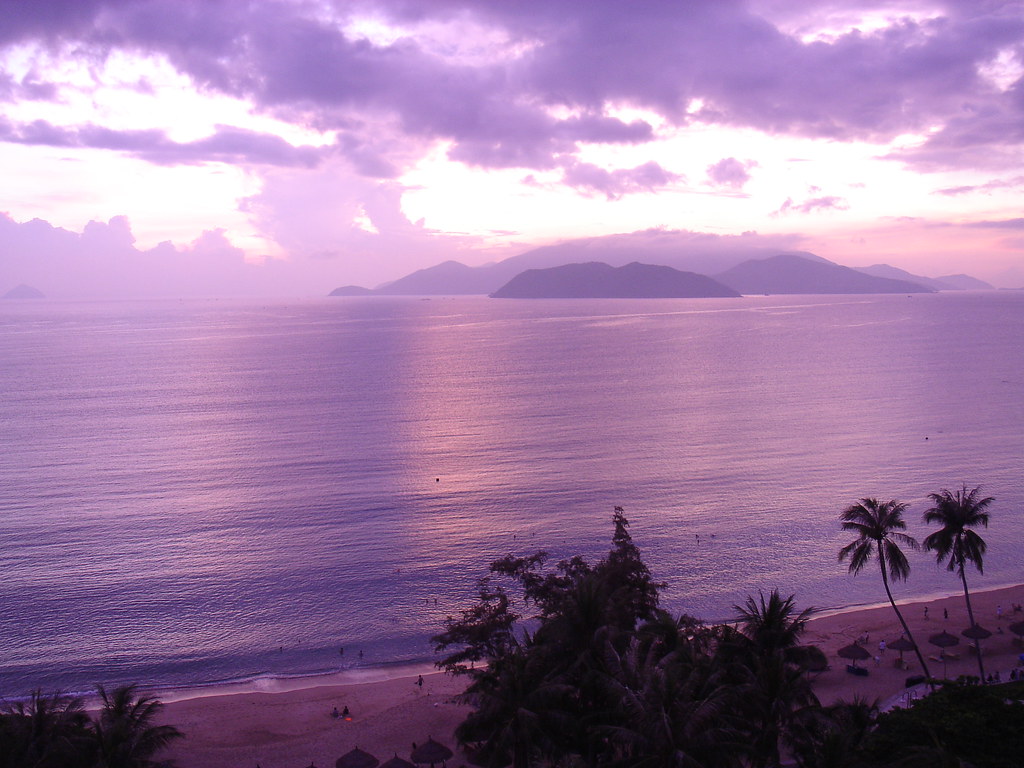
Violet Sunset - Nha Trang


Perfume Pagoda

Nha trang beach


Po Klong Garai Towers, Ninh Thuan


Hoan Kiem Lake - Return Sword Lake


Ha Long Grotto

(click image to view full-size)
Photo by Flickr

1 Dec 2008

Artisans to decorate streets for flower festival

There will be a frenzy of flowers at Hoan Kiem Lake in Hanoi next month, as craftsmen take over the centre with their artistic and floral creations.


The five-day event Flower Street Festival – Hanoi 2009, will welcome famous artisans and craftsmen from Hanoi ’s traditional villages to present their artwork made from hundreds of thousands of flowers, as well as their traditional products.

From December 31 to January 4, the festival will take over a 600m-long stretch of road, from the intersection of Dinh Tien Hoang-Hang Bai-Trang Tien- Hang Khay to Ba Kieu Temple alongside Hoan Kiem Lake .

The colourful flower beds will be designed by some of Hanoi ’s most famous florists, including Mai Hanh, Duc Hai and Nguyen Ba Muu. The fresh flowers will be accompanied by a range of materials, including silk and wood.


Artisans from Chuong village-a famous conical hat-making village – will present an installation of conical hats in different sizes, while artisans from the fan-making Chang Son village will display a massive fan, measuring 9m wide and 4.5m high.

Artisan Lan Tuyen will provide a warm welcome to the festival grounds, creating a peach-blossom-shaped gate from bamboo tape fans. Typical old quarter mossy-roof houses will be replicated by artisans Nguyen Manh Tuan from Bat Trang pottery village, while massive lotus-shaped lanterns will also adorn the lake.

“Flower beds and art installations will be in harmony to ensure that this will be the most stunning festival Hanoi has ever seen,” said flower artisan Nguyen Manh Hung, the main designer of the festival’s flower decorations.

Hung will also impress tourists with ao dai (traditional dress) collection made from rattan, silk flowers, dried flowers and leaves.

According to deputy director of Hanoi’s Culture, Sports and Tourism Department Nguyen Khac Loi, the week is not just about livening up the city’s scenery, but is also a meaningful cultural activity to welcome the New Year.

“The festival is an event to present the golden skills of Ha Noi’s artists and to express the cultural quintessence of the 1,000-year-old capital,” he said.

“We expect to get as much experience as possible from this year’s festival to plan a flower festival next year – the year of the 1,000 th anniversary of Thang Long-Hanoi,” said one the festival’s organisers Nguyen Thi Hoa.


Unfortunately, recent flooding in Hanoi has destroyed most of the city’s flower fields, so the festival will have to present flowers from neighbouring provinces and from the “land of flowers“ in Da Lat.

“That is our biggest regret, that we can’t use flowers from Hanoi for a festival taking place in Hanoi ,” she said.

The festival’s organiser, Hanoi-based DC Music and Entertainment, will spend around 2 billion VND (117,000 USD) on the festival.
Source: Vietnamplus

History comes to life in Soc Son

A serene, almost sacred, atmosphere envelops the mountainous scenery of Ve Linh commune in Soc Son district, 30km north of Hanoi ’s centre, where legend has it Saint Giong flew back to heaven on his horse after defeating foreign invaders.


Colour abounds in the area, turquoise blue lakes – believed to be the footprints of Saint Giong’s horse – contrast against the palate of green mountains, hills and trees that mingle softly with the local bamboo, said to be coloured yellow from fire from Saint Giong’s horse. While stones intersperse the soft colours, giving the look of a painting.

An eco-tourism complex is planned for this most historic of places, covering 270 ha, and will include a golf course if you have had your fill of history.

Nguyen Van Lam, director of the Soc Temple Tourism and Relics Management said the area attracts around 15,000 visitors per year.


At the centre of the planned tourism project is Soc Temple , one feels free from the hustle and bustle of city life, and you can almost hear history calling in the wind.

The temple complex was built in the pre-Le Dynasty (980), and has altars to worship Saint Giong, his mother, and local gods and godesses. It was last restored in 1992 and was recognised as a national historic relic in 1962.

The most important feature of the temple buildings is the main altar, made from a mixture of clay, sugarcane juice, paper and lime. It is unique in Vietnam and forms the shape of the mountain ranges surrounding the complex. Seven statues are worshipped at the temple. The statues are standing, a rare sight in Vietnam as Nguyen Vu Dai, a temple guard, explains, “Standing statues are quite rare as most of local temples worship sitting statues.”


The back of the altar opens into a cave, that can be explored if you enter from the left and exit from right.

“Going from left to right symbolises going in by the father gate and out by the mother gate,” said Dai, “the cave represents the resting place of all Vietnamese ancestors.”

Stopping in the middle of the cave and looking towards the statue of Saint Giong, visitors should take a deep breath to receive the “holy” air from the back of the statue.

“You will get the strength of Saint Giong and live longer,” Dai said.

Mid way up Hon Da Trong Mountain there is a big white stone, cleft in two, that locals believe is Saint Giong’s armour. A statue of Saint Giong will be placed at the mountain peak in time for the 1,000 th anniversary of the founding of Thang Long-Hanoi in 2010.


“I have chosen an image of an 18-year-old boy with strong arms and legs for the statue,” said sculptor Nguyen Kim Xuan, the creator of Giong’s statue, “As there is no model for the heroic figure, the statue should symbolise the strength of Vietnamese people to maintain peace and wipe out invaders.”

The finished work will be 40m tall and weigh 50 tonnes.

Source: Vietnam Plus
Photo from: Xomnhiepanh